

A baby sleep schedule is a flexible daily rhythm of night sleep, naps, feedings, and calm bedtime routines matched to your child’s age, not a rigid timetable. Newborns need 14 to 17 hours of sleep per 24 hours, infants 12 to 16, and toddlers 11 to 14, and wake windows and nap counts shift as your baby grows. This guide walks through sleep needs, wake windows, and sample routines month by month, from newborn days through the second year.
Navigating infant and toddler sleep can feel like hitting a moving target. Just when you’ve figured out your baby’s rhythm, a growth spurt, motor milestone, or nap transition can upend it. If you’re wondering whether your baby is getting enough rest, how long their wake windows should be, or how to handle sudden nap struggles, you’re not alone.
How do sleep needs change as my baby grows?
Sleep needs change rapidly in the first 18 months as neurological pathways mature. A baby sleep schedule is a general, adaptable rhythm that balances sleep, feedings, play, and bedtime routines over 24 hours. A successful one follows your baby’s natural biological clock (circadian rhythm) and individual sleep needs rather than the clock alone.
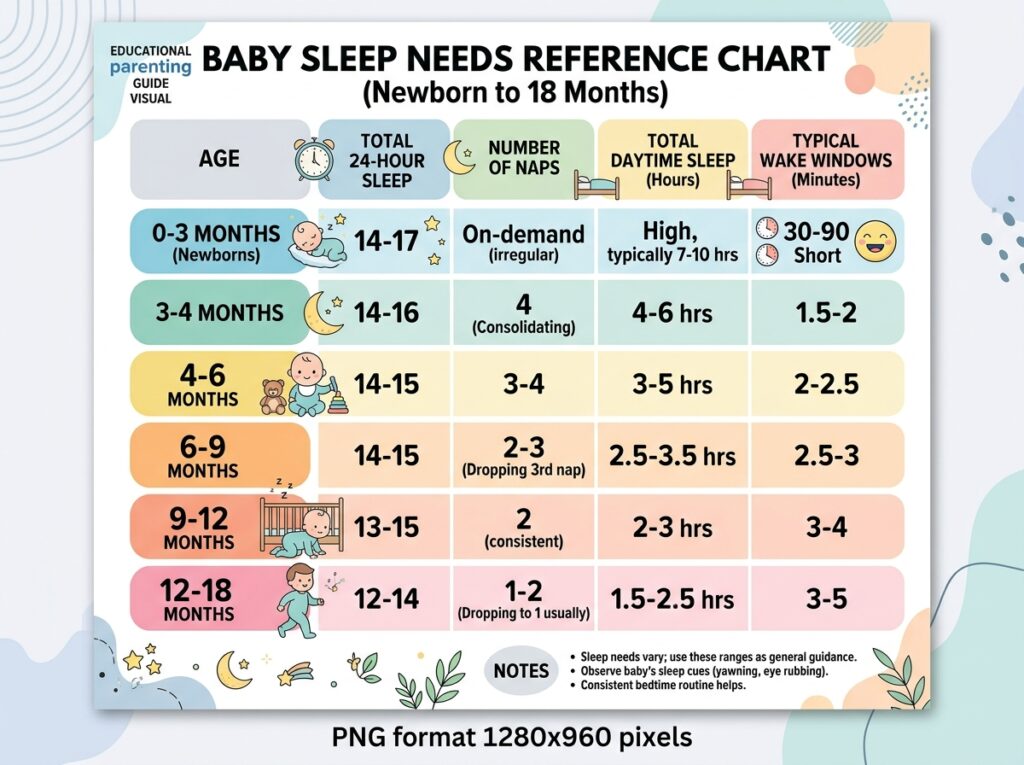
According to the American Academy of Sleep Medicine (AASM), recommended total sleep (naps plus nighttime sleep) falls into these ranges:
- Newborns (0-3 months): 14 to 17 hours per 24-hour period
- Infants (4-12 months): 12 to 16 hours per 24-hour period
- Toddlers (12-18+ months): 11 to 14 hours per 24-hour period. This is the range to keep in mind for a 13 month old sleep schedule or a 16 month old sleep schedule.
Wake windows vs. “by the clock” schedules
Young infants do best with wake windows; older babies do best with set clock times.
- Wake windows: A wake window is how long your baby can comfortably stay awake between sleep periods. Young infants rely on these because their homeostatic sleep pressure builds quickly. Putting a 4-month-old down based on their wake window prevents them from becoming overtired.
- “By the clock” schedules: By 8 to 12 months, circadian rhythms are much more robust. Moving to set nap times (for example, 9:30 AM and 1:30 PM) helps anchor your baby’s internal clock and simplifies daily planning.
Normal variation and individual rhythms
Every baby has a unique sleep temperament. High-sleep-needs babies may consistently land at the upper end of recommended hours, while low-sleep-needs babies thrive at the lower end and still seem happy, energetic, and healthy. Look at your baby’s overall mood, alertness, and growth rather than focusing only on the numbers. The same approach applies when you’re deciding when to transition to one nap: your baby’s own signals matter more than any single number.
Adjusted age for premature babies
For babies born before 37 weeks, use adjusted age. Calculate sleep expectations and wake windows from the original due date rather than the birth date. Neurological development drives sleep consolidation, so a 6-month-old born two months early will generally show the sleep patterns and wake-window tolerances of a 4-month-old.
How can I tell when my baby is tired before they become overtired?
Watch for early, subtle cues rather than waiting for crying. Crying, frantic limb waving, and inconsolability are late signs of overtiredness, and waiting for them is one of the most common scheduling hurdles. An overtired baby’s body releases stress hormones like cortisol and adrenaline, which make it significantly harder to fall asleep and stay asleep.
To prevent this, watch for sleepy cues during the final 15 to 20 minutes of your baby’s recommended wake window.
| Early sleepy cues (time for sleep) | Late overtired cues (needs soothing first) |
|---|---|
| Yawning or quiet sighing | Persistent crying or screaming |
| Staring off into space or losing focus | Arching the back or stiffening body |
| Turning head away from toys or people | Clenched fists and frantic kicking |
| Rubbing eyes, ears, or pulling hair | Inconsolability and extreme fussiness |
| Mild redness around eyebrows or eyelids | Difficulty latching or settling during feed |
Catching these early signals lets you move your child to their sleep space calmly before stress hormones take over.
What should my baby’s sleep look like from newborn through 4 months?
Expect short, light, frequent sleep. The first four months are a major transition, often called the “fourth trimester.” Newborn sleep cycles last 50 to 60 minutes, with roughly 50% spent in active (REM) sleep, which leads to frequent awakenings.
0 to 2 months: embracing irregularity
Night and day are often inverted because melatonin production hasn’t yet established a clear circadian rhythm.
- Wake windows: 30 to 90 minutes maximum.
- Nap pattern: 4 to 6 irregular naps per day, from 20 minutes to 2 hours.
- Strategy: Keep routines gentle and flexible. Expose your newborn to bright daylight while awake, and keep nights dim, quiet, and unstimulating.
3 to 4 months: the first major evolution
Around 3 to 4 months, your baby’s brain starts producing melatonin in a day-night pattern, and sleep cycles shift to include deeper, adult-like stages.
- When to start a sleep schedule: Rigid schedules don’t work for newborns, but 3 to 4 months is the ideal time to introduce a consistent sequence of events (for example, Feed → Activity → Sleep).
- The nap transition: Wake windows stretch to 1.5 to 2 hours between 3 and 4 months. Babies begin consolidating nighttime sleep and naturally move from 5 short naps to 4, and eventually to a stable 3-nap rhythm.
- The 4-month sleep regression: As sleep architecture matures, babies who used to drift off easily may suddenly wake every 1 to 2 hours at night or resist naps. This is a permanent developmental milestone in how their brain processes sleep.
What is a realistic 5 month sleep schedule through a 7 month old schedule?
Most babies at 5 to 7 months sleep 10 to 12 hours at night and take 2 to 3 naps. Night stretches are longer, with or without 1 to 2 night feeds.
For a 5 month old schedule, aim for wake windows of 2 to 2.5 hours. A typical schedule of a 5 month old includes three naps and roughly 3 to 4 hours of total daytime rest.
Sample 5 month sleep schedule (3 naps)
This 5 month sleep schedule gives you a predictable day while respecting your baby’s stamina:
- 7:00 AM: Morning wake-up and feeding
- 9:00-10:00 AM: Nap 1 (1 hour)
- 12:15-1:45 PM: Nap 2 (1.5 hours)
- 4:00-4:30 PM: Nap 3 (30-minute catnap)
- 7:30 PM: Bedtime routine and overnight sleep
The 6 month sleep schedule
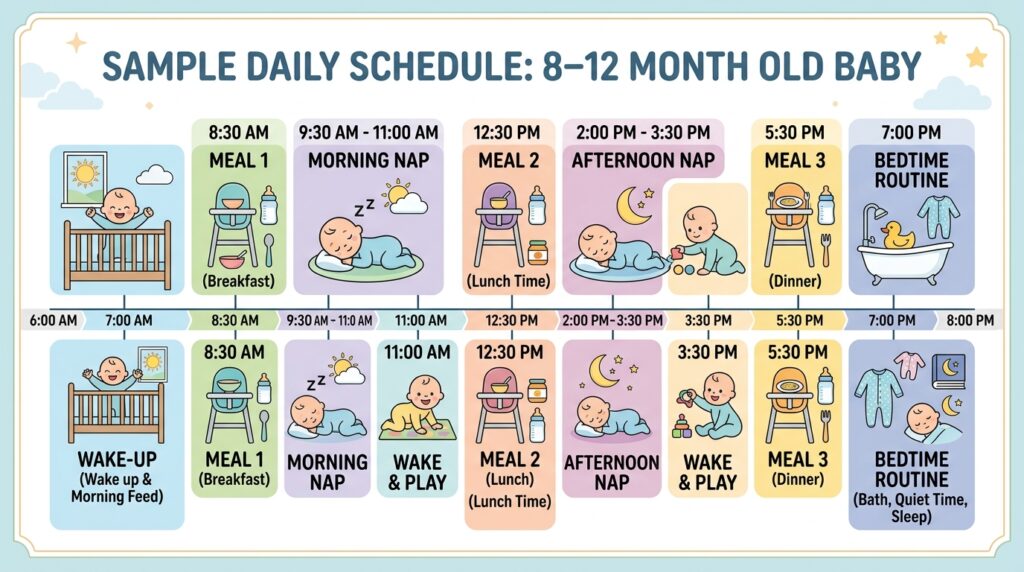
As your baby nears 6 months, they can handle longer wake windows of 2.25 to 2.75 hours. A predictable 6 month sleep schedule often keeps 3 naps, or begins shifting toward 2 longer naps if the evening catnap is consistently resisted.
Transitioning to a 7 month old schedule
Between 6 and 8 months, most babies drop the third afternoon catnap. A 7 month old schedule usually has two solid naps, one in the morning and one in the early afternoon, with wake windows of 2.5 to 3 hours.
Sample 7-month-old 2-nap schedule:
- 7:00 AM: Wake-up and morning feed
- 9:30-11:00 AM: Nap 1
- 2:00-3:30 PM: Nap 2
- 7:30 PM: Evening wind-down and bedtime
What is the best sleep routine and nap schedule for an 8 to 12 month old?
Sleep is often at its most predictable between 8 and 12 months, settled firmly on two daily naps. This happens even though your baby is in a period of high cognitive and physical growth: crawling, pulling up to stand, and experiencing peak separation anxiety.
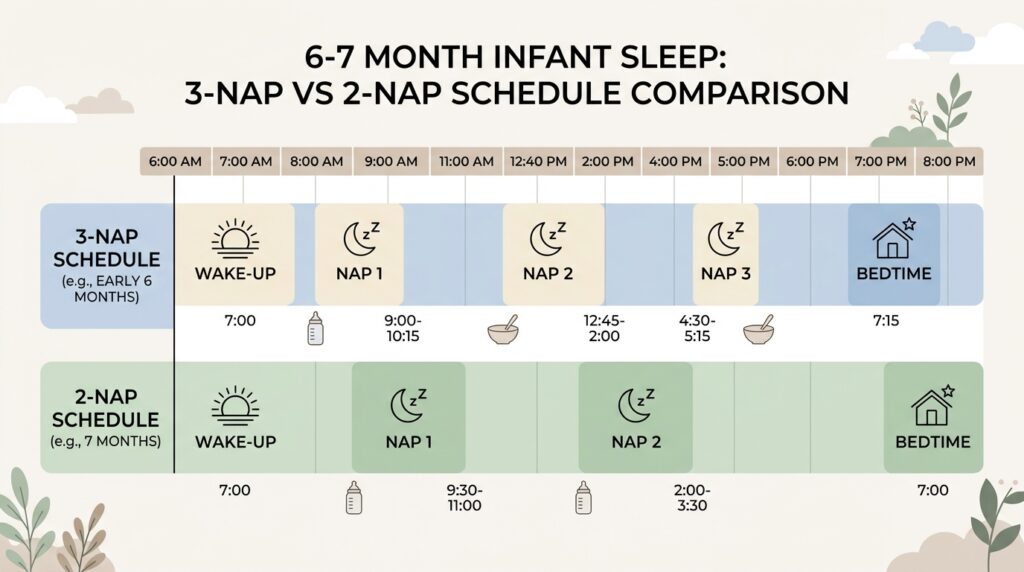
For an 8 month old nap schedule, wake windows typically stretch to 2.5 to 3.5 hours, often following a 2.5 / 3 / 3.5 hour pattern through the day.
Sample 8-to-10-month daily schedule
- 7:00 AM: Morning wake-up
- 9:30-11:00 AM: Morning nap (1.5 hours)
- 2:00-3:30 PM: Afternoon nap (1.5 hours)
- 7:30 PM: Bedtime
Establishing a consistent routine
Predictable cues are the heart of a good sleep routine for an 8 month old. A 15-to-30-minute pre-nap or bedtime sequence (a warm bath, fresh diaper, sleep sack, brief story, soft song, and a warm cuddle) creates a psychological bridge between active play and restful sleep. For more age-by-age guidance, browse our sleep articles here.