

A dream feed is a late-evening feed, typically between 9:00 PM and midnight, offered to a sleeping or drowsy baby right before you go to bed. Topping off your baby’s tummy without fully waking them can line up your baby’s longest sleep stretch with your own. Here’s what dream feeding infants involves, how to do it safely, and whether the dream feed newborn technique is right for your family.
Why Do Babies Wake Right After You Fall Asleep?
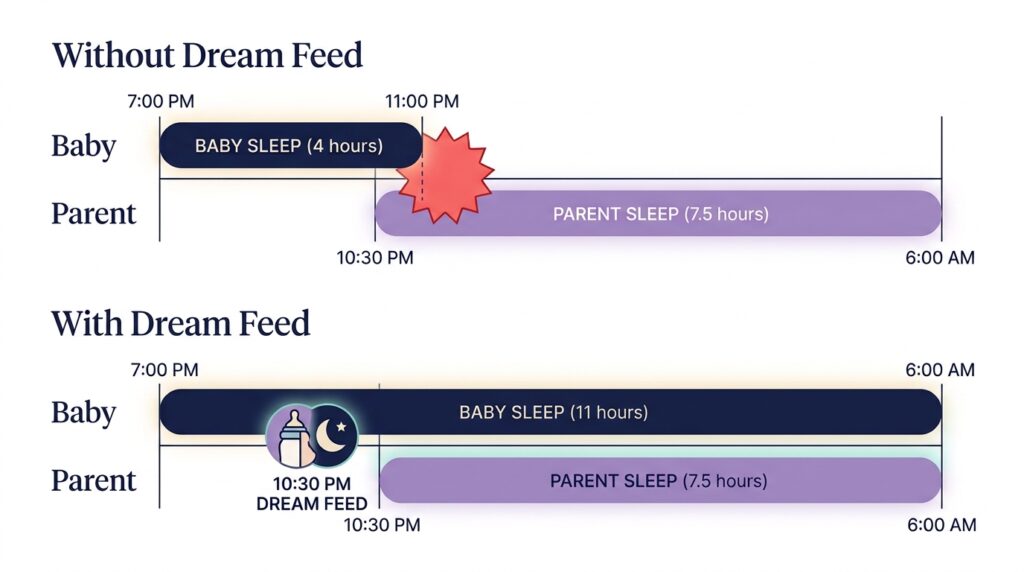
A baby’s longest sleep stretch often falls right after bedtime, while you’re still awake. Their longest stretch might run from 7:00 PM to 11:00 PM, while you do chores or unwind. Then you crawl into bed at 10:00 PM, only to hear a cry for a feed at 10:30 PM. A dream feed resets your baby’s hunger clock so their longest stretch overlaps with your own.
What Is a Dream Feed and How Does It Work?
A dream feed is a late-evening feeding offered to a sleeping or drowsy baby, right before you go to bed. The goal is to fill your baby’s tummy without fully waking them, so you both can sleep a longer block overnight. Pediatric sleep researchers sometimes call this a “focal feed” within a broader bedtime routine.
Dream Feeding vs. Regular Nighttime Feeding
The key difference is who starts the feed. In a regular night feed, your baby wakes up crying, alerts you, and needs full soothing. A dream feed is proactive: you start it while your baby stays semi-asleep.
| Feature | Regular Night Feed | Dream Feed |
|---|---|---|
| Who starts it? | Baby (by crying or waking) | Parent (before going to sleep) |
| Baby’s state | Fully awake, often distressed | Drowsy or sleeping |
| Environment | Dim lighting, soothing needed | Low light, quiet, minimal movement |
| Primary purpose | Responding to acute night hunger | Aligning sleep stretches with parent’s schedule |
Why Do Parents Use It?
- Longer uninterrupted sleep for parents: Captures a 4-to-6-hour stretch of sleep that coincides with your own bedtime.
- Fewer hunger-driven night wakings: Addresses biological hunger before it causes full awakenings.
- A gentle routine: Helps shape a predictable nighttime pattern without formal sleep training.
Does Dream Feeding Work for Every Baby?
No. Dream feeding is a popular tool, but its effectiveness varies from child to child. Small studies indicate that a late-evening focal feed can help infants achieve longer early-morning sleep stretches by around 8 weeks of age. Broader research shows an overall reduction in night wakings when a dream feed is part of a multi-part bedtime routine. Individual results depend heavily on why your baby wakes up.
When Dream Feeding Helps
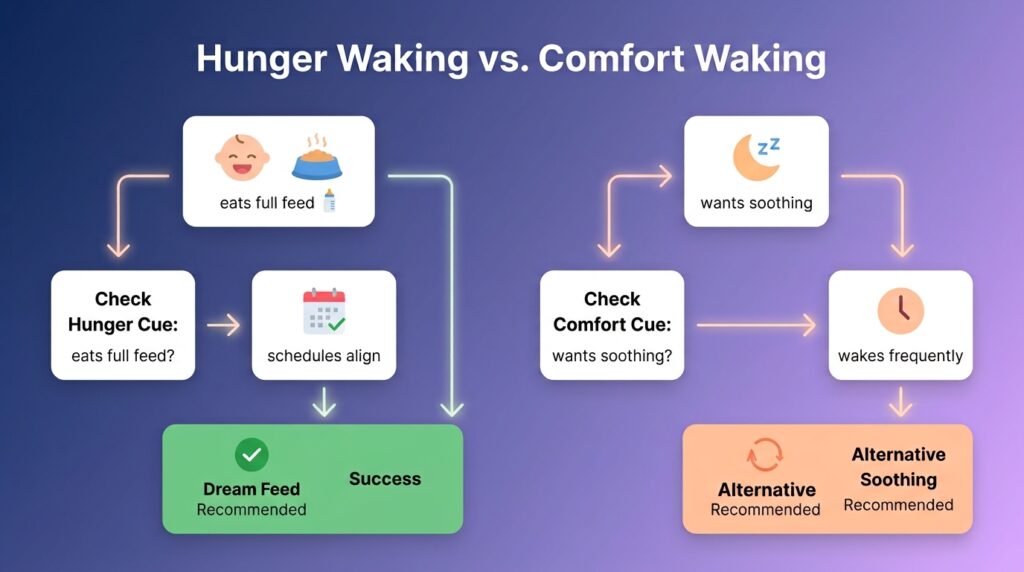
Dream feeding is most effective if your baby wakes mainly out of hunger. Young infants have small stomachs and high metabolic demands. Topping off their tank right before your sleep block means they aren’t waking purely because of an empty belly at 1:00 AM.
Limitations of Dream Feeding
A dream feed won’t resolve night wakings caused by:
- Habit or comfort: Waking up out of a desire for rocking, snuggling, or a pacifier.
- Sleep association needs: Inability to self-soothe between sleep cycles.
- Overtiredness or gas: Environmental discomforts or poor nap scheduling during the day.
When Should You Start Dream Feeding Your Baby?
The ideal window is between 1 and 4 months of age, or starting around 2 months once feeding is well-established.
In the first few weeks, frequent night feeds are essential for establishing milk supply (if breastfeeding) and ensuring steady weight gain. Newborns have very small stomach capacities and naturally wake every 2 to 3 hours. Once your baby reaches the 1-to-2-month mark and begins consolidating sleep naturally, a dream feed can help stretch those initial night blocks.
Note on sleep training: Dream feeding is not sleep training. Sleep training involves teaching a baby to fall asleep independently, whereas dream feeding is simply a timing strategy for night nutrition.
What Is the Best Time and Schedule for a Dream Feed?
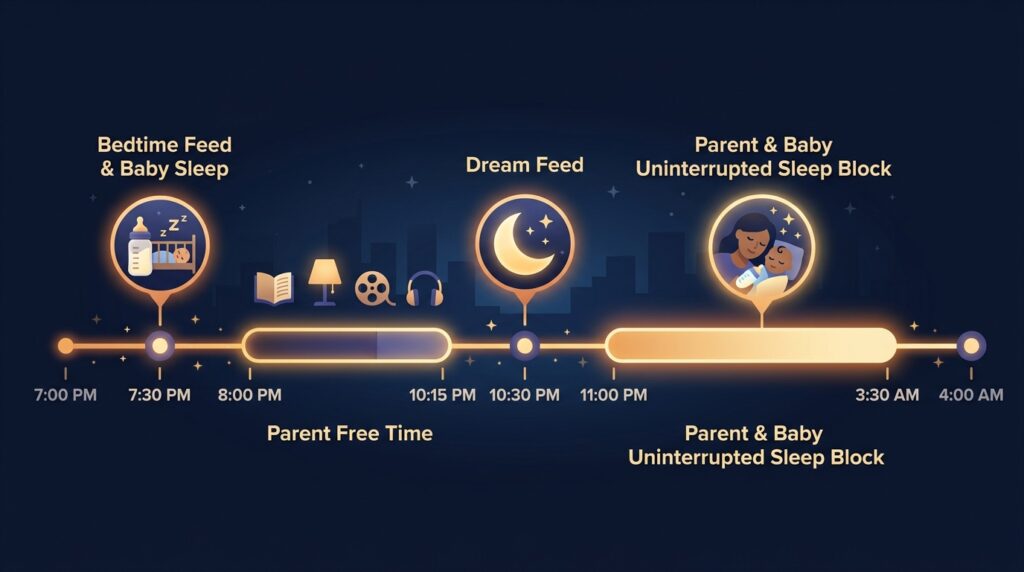
The sweet spot is usually 2 to 3 hours after your baby’s primary bedtime feed, between 10:00 PM and 11:00 PM (or generally within the 9:00 PM to midnight window).
Example Evening Schedule
- 7:00 PM: Start bedtime routine.
- 7:30 PM: Primary bedtime feed; baby goes to sleep in crib or bassinet.
- 8:00 PM – 10:15 PM: Parent personal time and unwinding.
- 10:30 PM: Dream feed (keep lights low, feed while drowsy).
- 11:00 PM: Parent goes to sleep.
- 3:30 AM – 4:30 AM: Baby’s next natural hunger waking.
Tip: Adjust timing to your baby’s unique patterns. If your baby naturally wakes up hungry at 10:15 PM, schedule the dream feed for 10:00 PM to stay ahead of the awakening.
How Do You Dream Feed Step by Step?
The key to a successful dream feed is minimizing stimulation so your baby stays in a sleep state.

- Prepare everything first: Have your bottle prepared or nursing pillow positioned before touching your baby, and make sure the room is dim and quiet.
- Lift gently: Pick your baby up out of the crib or bassinet softly, keeping voices down and avoiding bright lights.
- Skip unnecessary diaper changes: Don’t change the diaper unless it’s soiled or heavily soaked, because unnecessary changes will wake the baby completely.
- Offer the feed: Gently place the nipple or pacifier near their lips to trigger the rooting reflex (the natural instinct to turn and suckle).
- Keep it boring: Feed at a calm pace. Don’t talk loudly, sing, or make eye contact, as these signal to the baby that it’s awake time.
- Burp and resettle: Burp gently while holding the baby semi-upright, then return them to their crib on their back.
How Do You Dream Feed a Breastfed vs. Bottle-Fed Baby?
Both breastfeeding and bottle-feeding work well for dream feeds, but each needs specific positioning adjustments.
Breastfeeding a Dream Feed
- Gently brush your nipple against your baby’s cheek or lower lip to trigger the rooting reflex.
- Use a nursing pillow to support your baby while keeping a relaxed, semi-upright posture.
- Let your baby nurse until their sucking slows significantly or they release the latch naturally.
- Switch sides only if the baby seems actively hungry and responsive; otherwise, a single-sided feed is fine.
Bottle-Feeding a Dream Feed
- Prepare the formula or warm the expressed breast milk before picking up your baby.
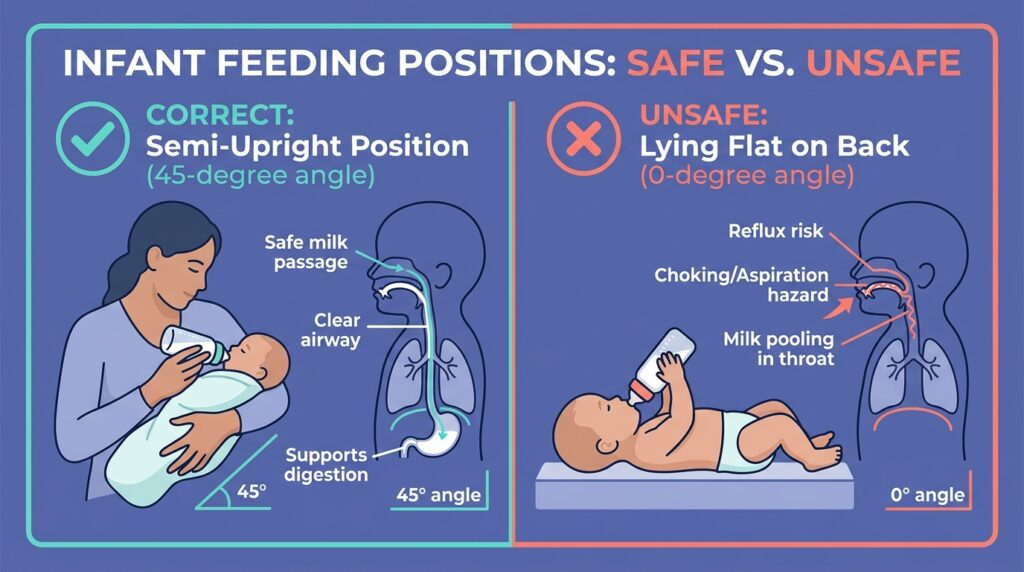
- Hold your baby in a semi-upright position, and never feed a baby lying flat on their back.
- Use paced bottle feeding, which lets the baby control the flow. Let them drink until they slow down or turn their head away.
- Never force the remaining ounces in the bottle.
Should You Burp Your Baby After a Dream Feed?
Yes, always burp your baby after a dream feed, but do it gently. Trapped air can cause gas discomfort and lead to a sudden waking 20 minutes after you put them back down.
Hold your baby semi-upright against your shoulder or sitting on your lap, gently patting or rubbing their back for a couple of minutes. If no burp comes after a few minutes of quiet upright time, keep them semi-upright for an extra minute before laying them down flat on their back.
Is Dream Feeding Safe? How Do You Avoid Overfeeding or Reflux?
When practiced correctly, dream feeding is completely safe for healthy, full-term infants. Follow these safety and positioning guidelines strictly:
- Follow safe sleep guidelines: Always return your baby to sleep on their back on a firm, flat mattress free of loose blankets, pillows, or soft toys, following standard American Academy of Pediatrics (AAP) recommendations.
- Never feed lying flat: Feeding a baby flat on their back increases the risk of choking, ear infections, and worsening acid reflux.
- Never prop a bottle: Always hold the bottle yourself. Never prop a bottle against a blanket or leave a baby unattended with a bottle.
Managing Reflux and Preventing Overfeeding
- Watch fullness cues: Look for subtle signs of satiety such as lip unsealing, turning away, relaxed hands, or slowing suckles. Never force a baby to finish a breast or bottle.
- Reflux care: If your baby has gastroesophageal reflux (GERD) or frequent spit-up, keep them upright for 10 to 15 minutes after the feed before laying them down.
What Should You Do When Dream Feeding Doesn’t Work?
If dream feeding isn’t producing longer sleep stretches, check these common issues:
- Baby fully wakes up: If light, noise, or handling wakes your baby completely, try dimming the room further, using a red nightlight, or omitting burping if they aren’t prone to gas. If they keep waking fully and struggle to resettle, dream feeding may not fit your child’s temperament.
- Baby refuses to eat: If your baby won’t latch or open their mouth, don’t force it. Try again the following night, or accept that your baby may not be hungry at that hour.
- Waking more frequently: If a dream feed causes more nighttime awakenings, it may be disrupting your baby’s natural sleep architecture. Discontinue the feed if this happens.
Give any dream-feeding trial 1 to 2 weeks to see if your baby adjusts before deciding whether to keep it or drop it.
When Should You Stop Dream Feeding, and How Do You Drop It?
Most families stop dream feeding between 3 and 6 months of age, and almost always by 6 to 8 months.
Signs It’s Time to Stop
- Your baby is sleeping reliably through the night past the dream feed.
- Your baby is gaining weight healthily and consuming adequate daytime calories.
- The dream feed starts disrupting their sleep or causing extra awakenings.
- Your baby becomes difficult to rouse for the feed or refuses to drink.
How to Drop the Dream Feed
There are two main methods:
- The gradual method (recommended): Reduce the amount offered every 2–3 nights. For bottle-fed babies, decrease the feed by 0.5 to 1 ounce every few nights (for example, 4 oz down to 3 oz, then 2 oz). For breastfed babies, reduce nursing time by 1–2 minutes per side until you reach zero, then drop the feed entirely.
- The cold turkey method: Simply stop offering the feed one night and see how your baby responds. If they wake up hungry at their usual dream-feed time, soothe them or offer a brief feed, gradually night-weaning over the following days.
When dropping night feeds, increase daytime milk intake or introduce solid foods (if age-appropriate and pediatrician-approved) so total daily calories stay sufficient.
When Should You Talk to Your Pediatrician?
Consult your child’s pediatrician before starting or stopping dream feeds if:
- Your baby was born prematurely or had a low birth weight.
- Your baby shows signs of poor weight gain or failure to thrive.
- Your baby has severe acid reflux, persistent projectile vomiting, or clear pain during feeds.
- Your baby keeps waking every 1–2 hours throughout the night despite age-appropriate feeding strategies.
Your pediatrician can provide personalized nutrition and sleep guidance tailored to your baby’s growth curve and development. For more help with baby sleep, you can find our other guides here.
Quick Summary
- What it is: A late-evening feed (between 10:00 PM and 11:00 PM) given to a semi-asleep baby to align their main sleep stretch with yours.
- Who it’s for: Best for infants aged 1 to 4 months whose night wakings are driven by hunger.
- How to do it: Keep lights dim and voices quiet, feed semi-upright, burp softly, and return baby directly to their back in the crib without changing diapers unless soiled.
- When to stop: Typically between 3 and 6 months, once daytime caloric intake is high and the baby consistently sleeps longer stretches.
- Safety first: Never feed flat, never prop bottles, and always follow safe sleep practices on a firm, flat surface.